Showing posts with label Indian Wars. Show all posts

August 2, 2026

Arizona's First Army Volunteers (1866)

Camp Lincoln C. 1868

 In 1866, Gov. Goodwin organized two companies of “native volunteers”, the first volunteers of Arizona, to be stationed at Camp Lincoln. Historian Donald W Lockhart wrote about them in 1936: They were “unique and almost comical in appearance. They were composed of Mexicans, renegade Tonto and Mohave Indians, Frenchmen, [and others], all poorly clad and practically all barefooted. Many [of the] Indians were in native dress, but all seemed disciplined and obedient to their superior officers. When these volunteers were on duty, the brutal Apaches knew they had met their match.”

June 28, 2026

Wickenburg in 1870

Henry Wickenburg

In 1870, Wickenburg was a young, booming town. Founded in 1863, it wasn’t officially incorporated until 1909. The boom was largely due to Henry Wickenburg's discovery of the Vulture Mine—“The biggest and richest gold mine yet discovered on this continent [the Vulture] is yielding plenty of ore,” the Weekly Arizona Miner stated. Two mills were running at this time, one of which had a whopping 40 stamps to crush the ore.

June 14, 2026

The Forgotten Pioneer & His Lost Gold

Nathaniel S “Boston” Graves died January 12, 1911, at the age of 88. He was “one of the earliest arrivals in this section of the Territory and also one of the most popularly known miners,” the Weekly Journal Miner explained. “He was more familiarly known as Boston.” He took ill with the flu (or grippe as it was called back then) late in 1910, having spent that year searching for “a ‘pothole’ that contained a vast amount of free gold.”

May 31, 2026

The Wickenburg Massacre: Nov. 5, 1871

“The stage for California left Prescott on the morning of Saturday, November 4, 1871, carrying the US Mail,” the Weekly Arizona Miner began. Aboard were a driver and six passengers. Three of the passengers were from Prescott: Frederick Sholom, William Kruger, and a “soiled dove” named Mollie Shepherd. The other three passengers were part of the Wheeler Expedition, a US Geological Survey mission to map the West that started the same year. Among these three was a popular, well-known 22-year-old writer named Frederick W. Loring- a native of Boston and a graduate of Harvard. The driver, John Lentz, was hired recently and was about to embark on his first return trip.


The first leg of the trip to Wickenburg “was almost a pleasure trip,” the same paper described. Loring told several people that he planned to write what he observed on his trip—that sentiment back East, believing the Indian Wars were nearly over, was fallacious, and he planned to redress the mistaken view.


But the following day would quickly become nationally infamous.

May 17, 2026

November 16, 2025

King Woolsey's 1864 Campaign for Revenge

King Woolsey was away from his Agua Fria ranch, which was located around present-day Dewey. Instead, he was with Governor John Goodwin along the Verde when a messenger came with disturbing news. Fifty Native Americans “made a descent on [his] herd at mid-day, and before the herders could alarm the men at the ranch, they succeeded in driving off all the animals but one or two, which they killed,” the Arizona Miner described. Except for three yoke of oxen that were actively plowing the land, 30 head of livestock were lost.


This was not the first large loss Woolsey experienced, and he vowed to wreak revenge. “He will organize a company to hunt and punish the thieves, and if it is as successful as the party he headed [previously], which slaughtered twenty or more of them, he will have a good revenge,” the paper continued. “He is one of our most daring and skilled Indian fighters, and believes fully…in the extermination policy. And in view of the importance of the expedition, the Governor has made Mr. Woolsey an aide upon his staff, with the rank of Lt. Colonel.” The chance of capturing the 50 Natives who actually made the raid was so slight, it was never even considered, so revenge it was.

November 17, 2024

1868: Four Daring and Successful Indigenous Raids in Four Days

The Weekly Arizona Miner was shocked. “The Indians…commenced the most daring, vigorous, persistent, and may we add, successful raids against the whites of this section that we have ever known or heard of them to make.” The newspaper was referring to a series of four raids in as many days. “And in every instance,” the paper continued, “ [they] have come out winners in the game of life and death.” 


It started in late October 1868. “Our people have been in a high state of excitement ever since our wily foes started upon this, their most brilliant campaign,” the paper declared.

September 3, 2023

Payson's 'Oldest Continuous Rodeo' Claim Proven False


Payson, Arizona, claims their rodeo is the "World's Oldest Continuous Rodeo since 1884." It's a contention that relies largely on oral legends. However, a review of the historical newspaper records refutes the assertion.

August 28, 2022

Embezzling Postmaster is Redeemed (1875)

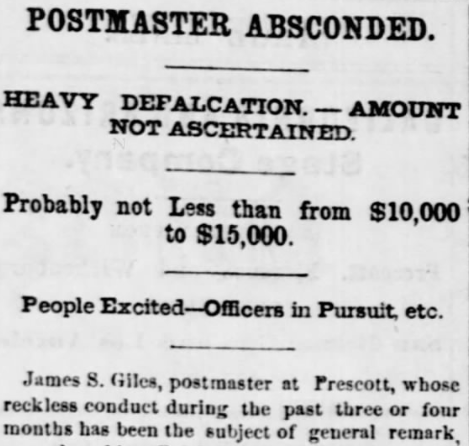
  James S Giles was a highly respected and true pioneer of Prescott, Arizona. He was one of the party that accompanied Governor Goodwin and Secretary McCormick to the territory in 1863. As chairman of the Judiciary Committee during the first Territorial Legislature, he introduced most of the first basic laws known as the “Chapters of the Code.” He was elected Speaker of the House in the second Legislature. Lately, he had been the postmaster for Prescott, so when he absconded with nearly $10,000 on August 14, 1875, it was a bombshell.

Still, there would be a happy yet poignant ending.

February 19, 2022

$7 Million in Gold Awaits to be Found

Initially, one might dismiss an account of over 230 pounds of placer gold just waiting to be found, but the Catholic Church had enough faith in the story that they employed fifteen men to try to locate it. Still, it remains hidden to this day.

October 25, 2020

1866: Indians Scare Off Pioneer Merchant

William Harrison Hardy had a good gig going. He owned businesses in a town named for him: Hardyville (present-day Bullhead City). He also owned an important and well-used ferry service at that point and a toll road that led to Prescott. Soon, he started opening businesses there that were successful, but in late 1866, he abruptly started to sell off all his interests in the Mile High City.


In 1901, at age 77, he revealed why to the Journal-Miner newspaper.

August 9, 2020

My Life as an Indian Scout (Albert Sieber)

Pleasure to meet you. 


My name is Albert Sieber, and I was considered one of the best Indian scouts in the Arizona Territory, if not the Southwest. I was born in Germany on February 19, 1844, and came to America as a young boy, the 13th of 14 children. 


Early in 1862, I enlisted in Company B, 1st Minnesota Volunteer Infantry. I saw some terrible sights during the Peninsula Campaign in the Army of the Potomac as a Corporal and a sharpshooter. I thought I was a goner at Gettysburg when a piece of a shell hit me in the head. I sat lying on the battlefield until long after the fighting before they found me. 

April 26, 2020

Buffalo Soldiers March Into Whipple

When the newspaper announced in March 1885 that “it has been definitely settled that the headquarters of the 10th Cavalry [of Buffalo Soldiers] will be on their arrival in this Territory at Whipple and that a company of the colored troops will also be stationed at that post,” the citizenry was apprehensive. They had read about “the inevitable [poor] reputation given the 10th Cavalry by certain journals in southern New Mexico and Arizona.”

However, the proud 10th Cavalry would quickly allay such fears, and the people of Prescott would become completely impressed by them. “Since their arrival in Prescott,” the paper later wrote, “the members of the 10th…are as well behaved and as soldierly looking a set of men that have ever been stationed at Whipple.”

March 29, 2020

Story Behind the Place Name: Poland Mine, Creek & Junction

His name was Davis Robert Poland, and he was a true frontier placer miner. He came to Yavapai County early, when one could walk down a creek bed trail and find large gold veins, embedded in quartz ledges, glittering in the sun. Indeed, this happened to Poland several times.

March 8, 2020

The Indian Uprising of 1872

The ruins of Camp Date Creek
From February through June 1872, Native Americans launched raiding attacks around and surprisingly close to Prescott. The newspapers were filled with accounts of Indian depredations during this time, and the citizenry was both frightened and filled with consternation.

Orders came from Washington to change the practice of largely shooting Indians on sight to one of feeding and educating them instead. Initially, however,  the Indians, many of whom were starving, became emboldened and started to attack.

October 13, 2019

The Indian Offensive of 1868

Although Indian attacks were a constant fear in the 1860s, they were not a constant occurrence. However, in the last third of 1868, the Native Americans definitely took the offensive.

March 31, 2019

Rough Rider Cofounder Gov. Alexander Brodie

Because he gave his life during the Spanish-American War, it is Buckey O’Neill who is the most widely remembered Prescott Rough Rider. However, when the regiment departed the Prescott depot to go to war amid the echoes of celebratory dynamite blasts, the Arizona Republic observed: “Col. Brodie is the most popular man in the command.”

March 10, 2019

1863: The Indian Raid on Peeples Valley

Abraham Harlow Peeples was one of the true early settlers of Central Arizona. He first arrived at Ft. Yuma in 1863 to prospect in the virgin wilderness of what would become Yavapai County. 

Peeples not only made mining claims, but he also quickly made a homesteading claim in a valley, 35 miles southwest of Prescott, which now bears his name. However, that winter, the Peeples’ ranch would suffer the crippling theft of 29 horses and mules.

November 25, 2018

Indian Wars Dispirited Early Thanksgiving Celebrations


The first Thanksgiving Day, November 9th, 1866, was a solemn one in Prescott. Some were thankful that the Union had been preserved, while others that the killing and destruction had finally ceased.

It was “the first time a day of Thanksgiving [had] been set apart in this territory,” the newspaper reported, and was “duly respected” with a community remembrance. However, the annual festivity would soon slip into neglect in Prescott and elsewhere in Arizona.

November 18, 2018

The Mysterious, Phantom Fort Misery Near Oro

Many are familiar with the first building in Prescott, and the oldest surviving log cabin in Arizona, “Fort Misery.” 

Then there was a second Fort Misery near Oro—or maybe there wasn’t. The mystery and controversy about the military presence near the banks of Humbug Creek during the Indian conflicts has flared up in recent years.