Showing posts with label archeology. Show all posts

December 15, 2024

Was Coronado’s Gun Found in the United Verde Mine?


It was late autumn 1900 when a minor cave-in occurred in the giant United Verde mine in Jerome. On December 3, as workers cleared the mess, they were astonished to find a newly exposed cave that contained a mysterious gravesite falloff artifacts. “It was with wonder and awe that the workmen first entered the cave and handled the relics that must have been laid away centuries [ago],” the Jerome News described, adding that it created quite an excitement in the copper town.

May 5, 2024

Arizona's 1st Telegraph Pole Was Erected at Ft. Whipple

Officer's Quarters Ft. Whipple (1871)

As 1873 dawned, the Weekly Arizona Miner lamented that Arizona was “about the only great geographical division of the Union that is not now connected with the Capital of said Union…by telegraph.” Indeed, Lt.-Gen. George R. Crook, the man in charge of fighting in the Indian Conflicts, requested that the War Department build a telegraph line from California into the Arizona Territory in 1871. However, by 1873, Crook had already made peace with the Apaches, and the “Indian Wars,” as they were called, were winding down. Yet the wiring of Arizona to the rest of civilization would still be of great benefit in case of conflict from Mexico, and Arizona “would no longer be isolated,” the Miner observed.

July 17, 2022

A Grave Robber's Remarkable Find


Meet John Love. In his day, at the turn of the last century, he was known as a “relics prospector.” Today he would easily be considered a grave robber. “Those who come in contact with him dub him queer, eccentric, etc., explaining that he was struck on the head in early youth by an iron bar and has suffered more or less seriously since,” the Arizona Republican reported. Still, the same paper also described him as “John Love, the well-known searcher for prehistoric relics…”

March 13, 2022

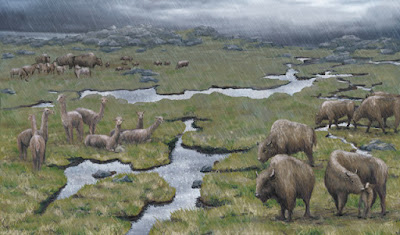
Pleistocene Prescott Valley

It was 1984 on the Fain ranch near the headwaters of the Aqua Fria River when A. Jordan peered into a 13-foot deep arroyo and noticed a partial skeleton of a mammoth. 


Soon, paleontologists from the Arizona Archeological Society, Yavapai College, Sharlot Hall Museum, and Northern Arizona University were busy unearthing the remains. Their work would also uncover the remains of three additional large mammals: a horse, a bison, and a camel.

November 22, 2020

The Chinese Den of Iniquity


No one knows what the business was actually named. A Sanborn-Perris mapmaker identified it only as “Chinese” in 1895. 


This writer might have considered it “The Chinese Entertainment House,” but authors of the archeological report, "Celestials and Soiled Doves..." used biblical verbiage to describe it as a “den of iniquity.” Specifically, it was found to be a “gambling parlor/saloon/opium den/drugstore, [that] filled many needs.”

September 6, 2020

What Yavapai County Has Sent to the Smithsonian


Yavapai County has sent hundreds of thousands of items to the Smithsonian Institution; most of these are insects and indigenous artifacts, but several other intriguing and occasionally mysterious items have been sent there as well. The most interesting of these are the items that the Institute had never seen before.

August 30, 2020

Amazing Discoveries of Yavapai Co. Ancients


Mummies, pygmies, and three separate accounts of giants are some of the amazing finds that were made in the early 20th century in the greater Yavapai County area. Back then, “Indian artifacts” were a commercial business where people would sweep up arrowheads and any other objects and sell them in stores or on the roadside.


Shamefully, much of this activity devolved into what could only be described as grave-robbing until the Antiquities Act made such behavior illegal. However, these relic hunters would occasionally come across some astonishing items…

July 19, 2020

The Mysterious Figurine-Making Forest People

Were these 1000-year-old artifacts tokens of black magic?


Much mystery surrounds the small, clay figurines found in the forest south of Prescott, as well as the people who made them.

July 12, 2020

The Intriguing Story of Cathedral Cave


Dud Clark had been contracted to build a road from Prescott to Ash Fork when Lee Burhans called out to him. “Burhans was a member of a picnic party and was going through a large cave that had been well known for years, when he found a small opening that he had never before perceived,” the paper described. Peering through the hole with a match, he noticed that this opening was just below the roof of a large cavity. Lee got Dud, who then lowered a rope and descended to the cave floor with an “automobile lamp.” When he turned it on, his jaw went slack.

May 31, 2020

The Prehistoric Residents of Mayer, AZ

The modern town of Mayer, AZ, was not the first time this area was inhabited; at least three times previously, the area was settled by indigenous, prehistoric peoples. Radiocarbon dating revealed human activity between the 6th century AD and 1800 AD.

January 26, 2020

Archeological Survey at 140 N. Granite St.


In 1994, 16 people from the Yavapai Chapter of the Arizona Archeological Society spent over 400 hours investigating the lot at 140 North Granite St.

“The team of dust-caked investigators found building foundations and artifacts seven feet below street level,” the Courier reported. Although nothing particularly mysterious or unexpected was located, the excavation did offer insights into everyday life and what happened with some of the tons of waste material from the Great Fire of 1900.

November 10, 2019

Before Prescott Valley, There Was Massicks, AZ

The Barlow Massicks' "Castle on the Creek"
Thomas Gibson Barlow Massicks had just visited his Catoctin Mine and was riding back to Prescott in his buckboard, May 17, 1898. Although the road was especially rugged, Massicks made haste, bouncing about abruptly as the buckboard wheels dropped into a rut or launched off a bump. As he endured the ride, his six-shooter slowly made its way out of its scabbard and fell to the wagon floor. With the sheerest of bad luck, the gun landed on its hammer and fired, barely missing Massicks’ right kidney and coming to rest on his right lung.

Despite excruciating pain, Massicks drove his team even harder in hopes of reaching Bates’ Station, 4 miles away. When he arrived at the house, he “was so far gone from the loss of blood and from the shock, that he was almost in a state of collapse, and had to be assisted into the house,” the paper reported.

Mr. Bates immediately took Massicks’ buckboard and completed the trip to Prescott to summon a doctor who undoubtedly saved his life. However, the wound would slowly prove mortal both for Massicks the man and for the town of the same name, which was located in the Prescott Valley area on lower Lynx Creek.

September 8, 2019

The Hohokam Village Under the Cordes Junction Interchange

Each day, over 40,000 vehicles pass through the Cordes Junction interchange connecting I-17 with Arizona Highway 69. Few are aware that they are passing over an ancient, northern village of the Hohokam people.

Anytime the Arizona Department of Transportation prepares to build, they are required to investigate the area “for the potential to encounter cultural resources (including) prehistoric archeological sites.” When ADOT looked to expand the Cordes Junction interchange in the later portions of the first decade of the 2000s, they found an ancient Hohokam village surprisingly full of artifacts.

November 18, 2018

The Mysterious, Phantom Fort Misery Near Oro

Many are familiar with the first building in Prescott, and the oldest surviving log cabin in Arizona, “Fort Misery.” 

Then there was a second Fort Misery near Oro—or maybe there wasn’t. The mystery and controversy about the military presence near the banks of Humbug Creek during the Indian conflicts has flared up in recent years.

July 22, 2018

Prescott's Other History Museum: Ft. Whipple

Due to a mature tree rooting its way into a sewage pipe, the Fort Whipple Museum had been closed for six months. But now it's reopened, and it offers a unique and charming visit into the fort's past.

"If you want to learn the history of Fort Whipple from its military beginnings in 1864 to the modern-day Veterans hospital, it’s all here in riveting exhibits with crisp text, historic photographs, and compelling artifacts. Friendly, knowledgeable docents will give you a tour of the exhibits and answer any questions you might have."

February 25, 2018

Road Crew Finds Giant Skeleton on Sycamore Creek

In February 1913, a road crew started digging "where the grade of the Verde railway passes" over Sycamore Creek in order to facilitate improvements. Soon, they uncovered evidence that they had found a prehistoric gravesite. What shocked them further was the enormous size of the bones located within it.

It was later calculated that this humanoid skeleton must have stood at least 8 feet tall.

August 6, 2017

1911: Giant Humanoid Skeleton Unearthed in Yavapai County UPDATED


(Not the skeleton found in AZ)
The 1911 monsoon floods had cut a new wash through the farm that Peter Marx had been working since 1870. By chance, this new cut exposed some bones sticking out of its bank. Marx went to investigate and quickly unearthed a large leg bone about twice the size of a human's.

Puzzled, he wondered what animal it could have come from.

He continued to dig, finding more large bones until, about three feet in, he discovered a giant human skull!

March 26, 2017

The Findings at the Fitzmaurice Indian Ruin


The Fitzmaurice Indian Ruin today.

Most of the commuters who go up and down Stoneridge Drive each day probably have noticed a peculiar zig-zagging fence surrounding a hilltop east of the road.

They might wonder: "What is this fence guarding?"

Answer: Perhaps the most significant, undeveloped tourist attraction in all of Yavapai County!

The Fitzmaurice Ruin is far more than a few scattered rock formations. The 27-room main pueblo and its several satellite structures encompass the largest Indian ruin in the Prescott region.

November 6, 2016

Prescott's "Double-Decker" Brothel

Arrow shows the location of the Double-Decker Brothel on Granite Street
 in this 1890 lithograph.

This 1885 photo, taken from the Old Courthouse,
reveals the back of the Double-Decker Brothel.
Before the downtown parking garage was built on Granite Street, the opportunity was taken to make an archeological dig of this portion of the old red-light district. Among several other things, this project unearthed the colorful story of Prescott's only two-story brothel.

In archeology, the prime artifacts are most often found in the areas where the refuse was dumped. As a result, (and speaking of dumps,) the true star of this story is: "The Privy at Prescott's Double-Decker Brothel."

Seems the old "Double Decker" was one of them pricy, high-class type joints. That is, if what they threw in the crapper is any indication...

September 18, 2016

Prescott's First Building

"Fort Misery"

Originally meant to be a temporary storefront, the meager two-room log cabin would grow a history and reputation as tall as a skyscraper.

Although the structure would never be associated with the military, it would soon earn the moniker: "Fort Misery"...