 |
| An Arizona Black Diamond Rattlesnake |
Where there are rattlesnakes, there are bound to be some interesting and amazing stories, and Yavapai County is no exception.

Anecdotes of Prescott History Brought to Life From the Pages of Old Newspapers and Other Sources.
|
| An Arizona Black Diamond Rattlesnake |
Where there are rattlesnakes, there are bound to be some interesting and amazing stories, and Yavapai County is no exception.

Today, Skull Valley is a sleepy little burg, but there was a time when the town had several area mines, a quartz mill, a dairy, a number of saloons, and a 36-room hotel.

 |
| Prescott Journal-Miner, 2/9/1917 Pg. 6 Col. 5 |
They would usually appear in February after the harshest days of winter, and stayed until May. Reports of thousands upon thousands of ducks and other waterfowl were annually noted until the climate took a turn toward our more arid conditions today.
A report in the Prescott Journal-Miner in 1917 stated that “the sun was obscured for over five minutes” as a gigantic wave of migrating ducks was settling in for the Spring in Williamson Valley. One man who wanted to boost tourism via duck hunting proclaimed to the Weekly Journal-Miner: “It is safe to say that 80 percent of all waterfowl flying from the north to the south use Williamson Valley as their course.”
Yet despite these incredible numbers, is it really possible to bring down thirteen ducks with only two shots, as one pioneer rancher claimed?
 Arizona is known for straight-line winds, red flag warnings, and dust devils that can be strong enough to create tornado-like destruction, but actual tornadoes? Indeed, there have been rare times when the Quad-Cities area fell victim to genuine twisters.
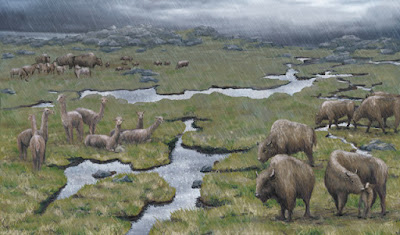
It was 1984 on the Fain ranch near the headwaters of the Aqua Fria River when A. Jordan peered into a 13-foot deep arroyo and noticed a partial skeleton of a mammoth.
Soon, paleontologists from the Arizona Archeological Society, Yavapai College, Sharlot Hall Museum, and Northern Arizona University were busy unearthing the remains. Their work would also uncover the remains of three additional large mammals: a horse, a bison, and a camel.

What did the first pioneers eat? Basically, whatever they could get their hands on! Fortunately, Yavapai County’s diverse ecosystem includes many fruits that grow in the wild. Here is a listing with pictures and the lore surrounding their medicinal uses:

For those back east, it meant troubling news stories, but for residents of the southwest, the Cold War was much more tangible. It was a time when Prescott residents would occasionally be awakened to the ground shaking and an orange glow in the western sky from nuclear testing at Nevada’s Yucca Flat Proving Ground.

Yavapai County has sent hundreds of thousands of items to the Smithsonian Institution; most of these are insects and indigenous artifacts, but several other intriguing and occasionally mysterious items have been sent there as well. The most interesting of these are the items that the Institute had never seen before.

Dud Clark had been contracted to build a road from Prescott to Ash Fork when Lee Burhans called out to him. “Burhans was a member of a picnic party and was going through a large cave that had been well known for years, when he found a small opening that he had never before perceived,” the paper described. Peering through the hole with a match, he noticed that this opening was just below the roof of a large cavity. Lee got Dud, who then lowered a rope and descended to the cave floor with an “automobile lamp.” When he turned it on, his jaw went slack.


 |
| Old City Dam, 1920s |


