 |
| Iron King Mine |
Despite being isolated in the wilderness of Arizona, mining camps still enjoyed wondrous and touching Christmas celebrations in 1903.

Anecdotes of Prescott History Brought to Life From the Pages of Old Newspapers and Other Sources.
|
| Iron King Mine |
Despite being isolated in the wilderness of Arizona, mining camps still enjoyed wondrous and touching Christmas celebrations in 1903.

Paul and Jack Fodge were two brothers with dubious reputations. Aged 26 and 23 respectively, both had already spent time in prison. They didn’t exactly exhibit criminal mastermind-ship either when they decided to hold up a large group of cowboys and their companions at an early, holiday-season dance on November 14-15th, 1931.


The genesis of White Horse City was the locating of three mines in the Walker district in the Spring of 1899. The original owners, GM Wright, CW VonWolfe, and R Horsecroft, founded the Lone Pine, Hammer, and White Horse mines. “The property is located only seven miles from [Prescott] in the mountains just east of Lynx creek and to the right of the McCabe road,” the Weekly Journal Miner described. These mines were located between the highly successful McCabe and Mudhole mines in the Walker district.

Consensus knows that Prescott gets snow, but it seldom lasts long—often melting away before evening. This was the reasoning behind the city selling off its “excess” snow removal equipment. But then in mid-December 1967, a below-freezing cold-snap accompanied by four waves of heavy snow eventually produced 72 inches with drifts measuring up to 10 feet.
Ironically, it was the city of Phoenix that sent ten snowplows, at its own expense, to help with the crisis.
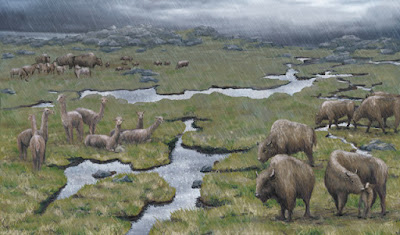
It was 1984 on the Fain ranch near the headwaters of the Aqua Fria River when A. Jordan peered into a 13-foot deep arroyo and noticed a partial skeleton of a mammoth.
Soon, paleontologists from the Arizona Archeological Society, Yavapai College, Sharlot Hall Museum, and Northern Arizona University were busy unearthing the remains. Their work would also uncover the remains of three additional large mammals: a horse, a bison, and a camel.

1870 dawned with the usual optimism of a new year in Prescott, but underneath lay a sense of anxiety. The first edition of the 1870 Weekly Arizona Miner wrote: “Our inveterate foes—the Indians— have been on their good behavior for a number of weeks past, and have not recommenced hostilities, hereabouts. But judging from the fact that they have commenced swarming around many settlements, we fear that, ere long, they will commence their business of killing and plundering, and we advise our people to be on the lookout for them.”
The newspaper would have done well to tell its readers not to travel alone and double their herders. For it was the Indians' strategy to begin a campaign of ambushing lone travelers and lightly guarded stock.

William Zadoc “Zeb” Wilson was proud of the brand-new boiler at his sawmill. He travelled to the Ohio manufacturer to deliver the desired specifications himself. According to the Journal-Miner, he “paid an extra price to have certain portions of it built extra strong.” When the boiler first arrived, it was examined by an engineer at Whipple, and he testified that “he considered it the best boiler in the county.” Wilson’s pride was only equalled by the meticulous care he gave his new boiler.
However, at 7:30 in the morning of November 19, 1887, this brand-new, prized boiler would blast Wilson and five other workers straight into the afterlife. Worst of all, it was found to be a premeditated act.
 |
| Gurley Street, 1933 |
 |
| Rev. HW Read was Agent for the Duke's and Co. stage. |

