March 30, 2025
The Great Flood of 1891
One year after the terrible storm that caused the Walnut Grove dam disaster, an even worse, two-part storm flooded Yavapai County.
June 12, 2022
What It Was Like to be an Extra in "Junior Bonner"
Sam Peckinpah was in Prescott directing the 199th movie made in Yavapai County, “Junior Bonner, when he noticed a nude painting titled “Olympia” by Earl MacPherson. Peckinpah thought it would be perfect hanging behind the Palace bar for some scenes he would shoot there. When asked if the movie could use his painting, MacPherson bargained that they could if he was hired as an extra. Peckinpah was happy to agree. Thus began an interesting, four-day, behind-the-scenes experience for the painter.
March 13, 2022
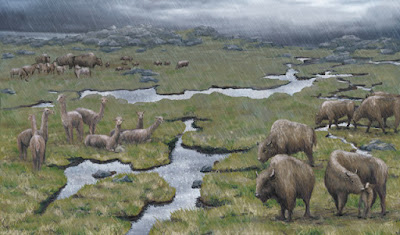
Pleistocene Prescott Valley
It was 1984 on the Fain ranch near the headwaters of the Aqua Fria River when A. Jordan peered into a 13-foot deep arroyo and noticed a partial skeleton of a mammoth.
Soon, paleontologists from the Arizona Archeological Society, Yavapai College, Sharlot Hall Museum, and Northern Arizona University were busy unearthing the remains. Their work would also uncover the remains of three additional large mammals: a horse, a bison, and a camel.
April 25, 2021
NEWSFLASH: Small Town Prescott Still Exists!
After a thorough search, lasting twenty years, this author and observer found a treasure that many have been missing for some time: Small-Town Prescott.
Where is it located, you may ask? I found it in the reflection of an equally small cup of coffee!
February 14, 2021
Prescott's 50th and 100th Anniversary Celebrations
Ironically, Prescott’s 50th anniversary was largely celebrated... elsewhere. It was the Phoenix Board of Trade that had the idea of celebrating the 50th anniversary of the founding of the territory, and they would make sure they hosted the event.
September 16, 2018
The Story Behind Prescott's Street Cars UPDATED!
It was this level of excitement that announced the mundane arrival of the first railroad ties for the Prescott and Mt. Union Railway Company.
July 22, 2018
Prescott's Other History Museum: Ft. Whipple
"If you want to learn the history of Fort Whipple from its military beginnings in 1864 to the modern-day Veterans hospital, it’s all here in riveting exhibits with crisp text, historic photographs, and compelling artifacts. Friendly, knowledgeable docents will give you a tour of the exhibits and answer any questions you might have."
June 17, 2018
Famous Harvey Houses Supplied by Del Rio Ranch
May 13, 2018
The "Graces" Who Got Things Done in Prescott
Each served Prescott and Yavapai County dutifully in their own ways, but when their good friend, Sharlot Hall, passed away, they came together to make sure that the Sharlot Hall Museum would not only stay open but would begin to grow into the facility it is today.
January 1, 2017
1915: 6 Ft. Snow Drove Lions Onto Ranches--Hardly a Colt Survived
The winter of 1915 in Yavapai County was one of the wettest in the area's history. Wave after wave of heavy moisture came through the Prescott area, stretching all the way down into the Sonoran Desert. (Ultimately, this unusually wet winter would change the ecosystem of the Prescott National Forest forever, introducing the white-tail deer to the area.)
In the valleys, there were copious amounts of rain, with Williamson Valley flooding several times. Initially, ranchers were excited that "the ground was soaked to the grassroots," and they anticipated "one of the very best ranching seasons ever." (*1) However, this wet abundance would prove to be a two-edged sword.
October 16, 2016
Viola Jimulia: America's First Chieftess
In the 1930s, when the Prescott Yavapai were down to a population of around 50, Viola took over the role of chief (mayora) of the tribe, even before her husband, Chief Sam "Red Ants" Jimulla (pronounced gee-mew-LAH,) passed away in 1940, when he fell off his horse. (*1)
In fact, a December 1936 Arizona Highways article stated: "As far as is known, Viola is the only woman in America to hold the position of tribal head" (while the story curiously never mentioned Sam at all.) (*2)
August 20, 2015
The Miller Bros. Saved Prescott From Starvation
Sam and Jake Miller were two of the very first whites to lay eyes on the Prescott area when they arrived with the Walker Party in 1863. But unlike the other members of that party, the Miller brothers stayed. Had they not, the history of Prescott would have been much different and much shorter.
Imagine if "Prescott" was remembered only as an attempt to settle the area, an experiment that failed after only one year due to starvation and an Apache blockade of the town.
This could have very well been the case had it not been for the Miller brothers' nerves and the business they started in Prescott's earliest days.
July 27, 2015
The Great Date Creek Train Wreck
![]() |
| The Date Creek Wreck the next day. |
It was the night of August 26th, 1915. Oscar and Frank Pemberton were sitting on their porch watching a violent storm move from the mountains to engulf them and their surroundings. In the distance, the Santa Fe, Prescott, and Phoenix Railroad train was approaching a bridge three miles south of Date Creek station. As they were watching the engine make its way, the lights on the engine suddenly disappeared. More ominously, the steam whistle was left open, sending a scream of mourning across the valley.
The two men quickly saddled up to ride out to the scene at full gallop. At best, it was a simple derailment; at worst, people were dead and dying.
As the fierce rain pelted both man and horse, the pair rode up upon the worst train wreck to date on the SF, P&P.
June 22, 2015
1866: Mexican Volunteers Fight the Battle of Five Caves
![]() |
| Fort Whipple |
The Buffalo Soldiers were not the only segregated minority group fighting in the Indian Wars. Companies E and F of the Arizona Volunteers were made up of Mexicans. Although they spent much of their time in the Verde Valley at Fort Lincoln (later Fort Verde), they were initially stationed at, and finally mustered out, at Prescott's Fort Whipple.
Many openly questioned the effectiveness of using Mexicans to protect area settlers. However, once tested in battle, the office of the Governor of the Arizona territory stated: "Those who doubted the ability of our native troops to do good service are now convinced of their error." (*1)
It started on the evening of February 12th, 1867, and Company E was preparing for its most lauded victory in what would become known as "La Batalla de Cinco Cuevas" (The Battle of Five Caves).
May 14, 2015
Prescott was Hollywood for Silent Westerns
They are part of 16 modern movies that were all filmed, at least in part, in Prescott, Arizona. (*1)
But when it came to silent western movies, Prescott was a real "Hollywood." Incredibly, in the three years of 1913-15, over a hundred silent westerns were filmed in Prescott and the surrounding area.
The first movie ever made in Prescott was The Cringer.